Usually, astrologers check planetary transits (Gochar) solely based on the Moon or the Ascendant (Lagna). But this paints an incomplete picture. How do we know what effect a transiting planet will have considering the positions of all other planets?
Enter Ashtakvarga (अष्टक वर्ग), the highest form of mathematical Vedic Astrology. The word literally means "Eight-Fold Division." It calculates a planet's strength by combining the influences of the 7 main planets plus the Lagna (Ascendant). This system is the exact reason why two children born on the same day in the same city can have vastly different destinies—one might become famous, while the other remains ordinary!
🌌 1. The 96 Cosmic Influences (९६ प्रभाव)
The Mathematics of Planets
Formula: 12 Houses × 8 Factors (7 Planets + 1 Lagna) = 96 Influences.
Any transiting planet can cast a maximum of 96 different influences on a birth chart. Out of these 96, some are auspicious (शुभ) and some are inauspicious (अशुभ). Interestingly, Rahu and Ketu are entirely excluded from the Ashtakvarga system.
Jupiter vs. Saturn in Ashtakvarga
Fact: Mathematics proves Jupiter's benevolence and Saturn's strictness!
Out of the 96 influences, Jupiter (Guru) possesses the highest number of auspicious points (56 points). Conversely, Saturn (Shani) has the lowest number of auspicious points (only 39 points). This mathematically proves the Vedic principle that Jupiter is the most benefic planet, while Saturn is the harshest malefic.
📊 2. How the Point System Works (अंकों का गणित)
In Ashtakvarga, each planet grants auspicious "Points" (Bindus) to certain houses from its own position. For example, Mars always grants a point in the 3rd, 6th, and 10th houses from its placement. When we total the points given by all planets to a specific house, we determine the actual power of that house.
The Scale: The maximum score a planet can get in its own chart is 8, and the minimum is 0. A score of 4 is neutral. Let's decode what these scores mean:
✨ Ashtakvarga Points & Your Destiny
0-3
Weakness (कमजोर): A score below 4 indicates that the specific planet or house is weak. It will struggle to give positive results and may cause hurdles during its transit.
4-5
Average/Good (सामान्य): A score of 4 is neutral. A score of 5 gives positive, stable results and steady growth without extreme fluctuations.
6
Wealthy (धनी): If a planet scores 6 points, it makes the native incredibly wealthy, prosperous, and financially secure.
7
Popular & Powerful: A planet with 7 points creates a massive Rajyoga! It makes the person highly capable, widely respected, and exceptionally popular in society.
8
The Elite (गणमान्य): Extremely rare. If a planet scores a perfect 8, the native becomes an elite personality—a top politician, tycoon, or legendary film star. They possess supreme authority!
📐 4. Prastarashtakavarga: The Cosmic Grid
How is the Ashtakvarga Grid Built? (प्रस्थारष्टक सारणी)
To create this system, astrologers use a specific grid called the Prastarashtakavarga Table.
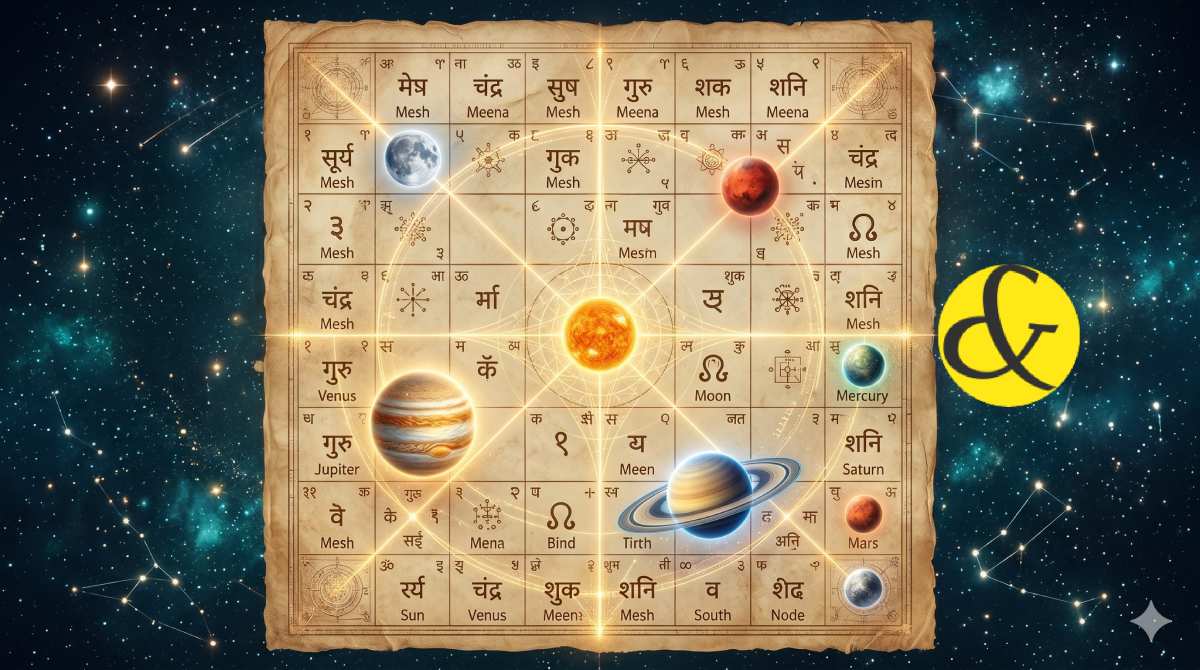
It consists of 12 vertical columns (representing the Zodiac signs from Aries to Pisces) and 8 horizontal rows (7 planets + 1 Lagna). Every zodiac sign is divided into 8 equal micro-sections called Kakshas (कक्ष), each measuring exactly 3° 45'.
The Speed Order: The rows are strictly ordered by the physical speed of the planets! Saturn (the slowest) sits at the top. Below him is Jupiter, then Mars, Sun, Venus, Mercury, and finally the Moon (the fastest planet). The Lagna, being faster than any planet, occupies the absolute bottom row. This brilliant grid contains exactly 96 Kakshas where planets distribute their auspicious and inauspicious results!
🌟 Astrological Conclusion: Ashtakvarga is the X-Ray machine of Vedic Astrology. A planet might look "debilitated" or "weak" in a normal Kundli, but if it has 6 or 7 points in Ashtakvarga, it will bless you with immense riches! Mastering this mathematical system allows an astrologer to predict the exact month, day, and hour of a life-changing event.