Vedic astrology consultations, readings and remedies

Planetary States in Astrology: Vakri (Retrograde), Margi & Ast (Combust) Explained
 AstroAnanta Team3 Min Read1,828
Key Takeaway
What are the different states of planetary motion? 1. Vakri (Retrograde): Appears to move backward (5th-9th house from Sun). Rahu/Ketu are always Vakri. 2. Margi (Direct): Moving forward. Sun/Moon are always Margi. 3. Atichari: Moving faster than normal. 4. Mandagami: Moving slower than normal. 5. Stambhit: Stationary pause before changing direction. 6. Ast (Combust): Invisible due to proximity to the Sun (e.g., Mars at 17°, Venus at 9°).
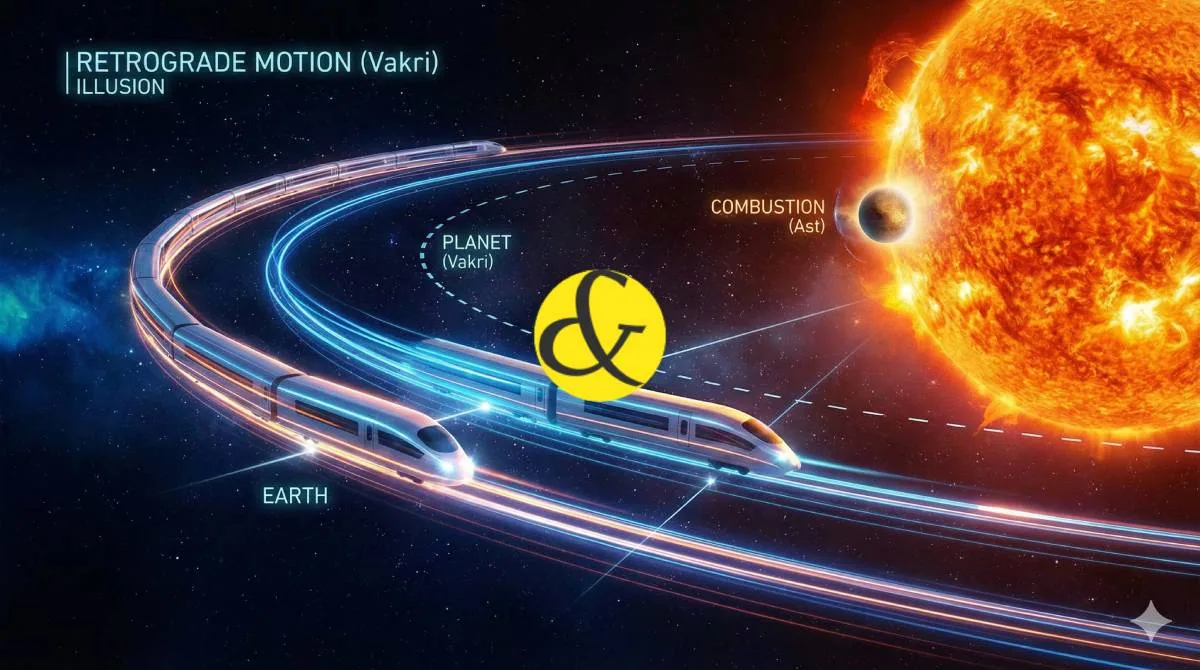
"Walking Backward"
When a planet transits from the 5th to the 9th house from the Sun, it is in a Retrograde state. It implies "Inverse Motion." However, planets do not actually move backward; it is an optical illusion caused by the Earth's speed relative to the planet.
"Walking Forward"
When planets move straight on their orbital path, they are called Margi. This is the normal state of motion.
- Sun & Moon: ALWAYS Direct (Margi). They never go Retrograde.
- Rahu & Ketu: NEVER Direct. They are always Retrograde.
"Over Speeding"
When a planet moves faster than its average speed, it is called Atichari. This usually happens to outer planets when they are in conjunction with the Sun.
जब कोई ग्रह अपनी सामान्य गति से अधिक तेजी से चलने लगता है, उसे अतिचारी कहते हैं।"Slowing Down"
When a planet moves slower than its average speed, it is considered Mandagami. This often happens before it is about to turn Retrograde or Direct.
जब कोई ग्रह अपनी सामान्य गति से धीमी गति में चलता है तब उसे मंदगामी माना जाता है।"The Pause"
Just as a car must stop for a split second before reversing gear, planets appear to stop moving before changing from Margi to Vakri (or vice versa). This frozen state is called Stambhit.
Also known as: Bheet Avastha (The Scared State).
ग्रह चाल बदलते समय कुछ समय के लिए स्थिर होते हैं। इसे स्तंभित या 'भीत' (डरा हुआ) अवस्था कहते हैं।When any planet comes too close to the Sun, it becomes invisible to the naked eye due to the Sun's blinding glare. In astrology, this is called "Ast" (Combust). A combust planet loses its power to give results (like a king overshadowing a minister).
जब ग्रह सूर्य के निकट होते हैं तब वह अस्त हो जाते हैं। बाहरी ग्रह सूर्य से 17 अंश की दूरी पर भी अस्त माने जाते हैं।📏 Combustion Degree Chart (अस्त अंश तालिका)
| Planet (ग्रह) | Combusts Within (अस्त होने की सीमा) |
|---|---|
| 🌕 Moon (चन्द्रमा) | Within 12° of Sun |
| 🔥 Mars (मंगल) | Within 17° of Sun |
| 🧠 Mercury (बुध) | Within 13° (12° if Retrograde) |
| 🧘 Jupiter (गुरु) | Within 11° of Sun |
| 💎 Venus (शुक्र) | Within 9° (8° if Retrograde) |
| 🪐 Saturn (शनि) | Within 15° of Sun |
While the degrees above are the standard calculation limits:
- Effective Combustion: Most astrologers consider a planet truly "powerless" only if it is within 10° of the Sun.
- Shadow Planets: Rahu and Ketu are shadow planets. They are never Combust (Ast) and never Direct (Margi).
Frequently Asked Questions

Shardiya Navratri 2026: कलश स्थापना मुहूर्त 11:50–12:37 व गज वाहन का शुभ संयोग
Read Now →
Why Your Kundli on AstroAnanta Is Different — Built on Real Calculations, Not Guesswork
Read Now →
Education and Astrology: Predicting Studies via the 5th House (शिक्षा और कुंडली का पंचम भाव)
Read Now →